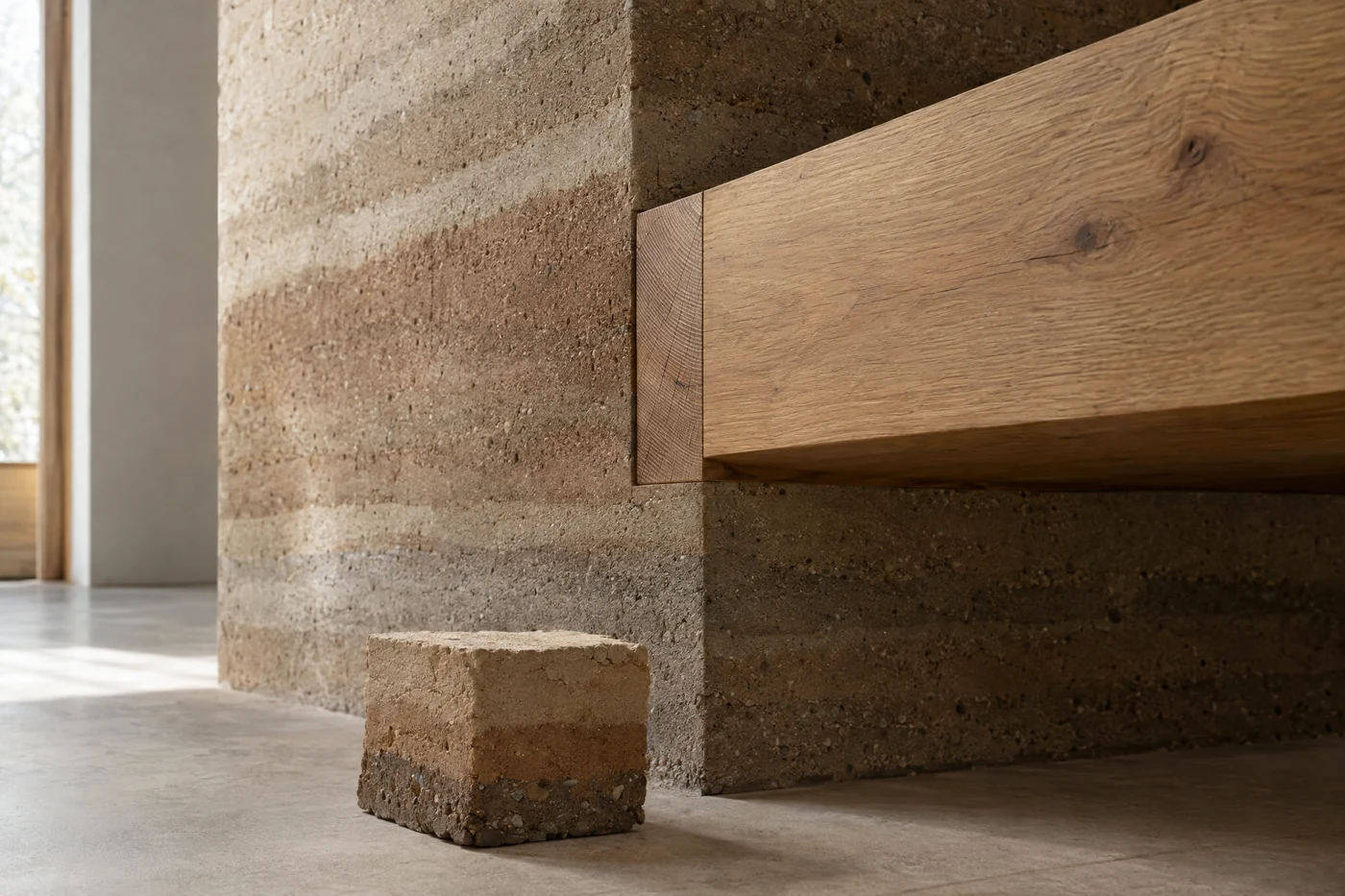
Introduction: the "new" naturalness
Cement and steel production generate substantial industrial emissions. This is one reason to reconsider timber, adobe and rammed earth. Material choices still need to account for performance, durability, local conditions and the complete life cycle.
But before we idealize them, it's worth looking at what works and what's just good-sounding marketing.
1. The advantages of natural materials - but where is the limit?
Timber systems, including cross-laminated timber (CLT), can reduce some buildings’ environmental impacts when appropriately designed. Installed timber stores carbon absorbed during tree growth; it does not continue photosynthesising inside a building. End-of-life treatment is therefore an important part of the assessment.
Use of local materials The advantage of loam and rammed earth is that the soil of the construction site itself can be the raw material. Transport is practically zero, and the local character is preserved. According to the study Rammed Earth Construction (Cambridge University Press, 2022), locally made earth walls require 30-40% less energy than fired brick.
Thermal and comfort advantages These materials have a high heat storage capacity - they heat up slowly in summer and retain heat in winter. According to an Australian experimental house, the CERES Earth Building Project (Melbourne, 2021), the internal temperature of houses with adobe walls is on average 4-5 °C more stable compared to environmental fluctuations.
Indoor applications require assessment of the complete product. Adhesives, preservatives and finishes can affect emissions; natural origin alone does not guarantee healthier indoor air.
All this is promising - but only as long as the execution is disciplined, the maintenance is consistent, and the use of materials does not become an end in itself. A poorly insulated adobe wall or improperly treated wood can quickly lose any "green" benefits.
2. Foreign examples where it already works
UBC’s Brock Commons Tallwood House in Canada is an 18-storey hybrid building. Its timber structure sits above a concrete podium and is complemented by concrete stair cores. It demonstrates the potential of combining timber with other materials in larger buildings.
Multi-storey timber buildings often use hybrid systems. CLT panels may be combined with glulam, concrete and steel; describing a building as entirely CLT based only on its main material can therefore be misleading.
Stockholm Wood City - Sweden The district under construction will consist of 25 wooden buildings on 250,000 m² with apartments and offices. According to the developers, the entire quarter will have a 30% lower carbon footprint than a traditional urban development (Atrium Ljungberg Development Plan, 2024).
Brettstapel systems - Austria, Germany, Switzerland The process of panels held together with wooden dowels without glue has been experiencing a renaissance since the 2000s. According to the Holzbau Austria Journal, these structures are 100% recyclable and can last up to 80 years.
Bamboo is an interesting building resource because of its rapid growth and useful mechanical properties. Structural use requires species-, product- and treatment-specific assessment; growth rate or one strength value cannot establish overall suitability.
These examples are not experimental pavilions, but functioning, inhabited buildings. What they have in common: technological discipline, long preparation, and the fact that they were all born at the cost of compromises.
3. Critical warnings - what marketing keeps silent about
Greenwashing at all levels Just because something is "wood" or "clay" does not automatically make it sustainable. According to the warning of the European Environment Agency (2023), "bio-based" building materials increasingly fall into the category of "greenwashing" because the entire life cycle is not examined.
Permitted timber-building height and construction depend on local building and fire codes and the chosen structural system. There is no universal storey limit; requirements must be checked for the specific project.
Lifespan and maintenance Natural materials are beautiful but delicate. According to the RIBA Journal (2023), several new adobe buildings in the UK developed waterproofing problems within 5 years, mainly due to the lack of eaves.
Supply constraints: expanding timber construction requires responsible forestry, traceable sourcing and suitable processing capacity. Availability, quality and transport distance need project-specific assessment.
Conclusion
The renaissance of wood, adobe and compacted earth is not a return to the past, but an attempt for architecture to respond to the climate crisis. These materials can reduce the carbon footprint of the construction industry and create a more humane environment.
But whoever thinks that this is the only way of the future is wrong. Natural materials work only if the technology, regulations and professional culture behind them are also renewed. The motto of "back to nature" is therefore only worth taking seriously as long as it is not driven by marketing logic, but by engineering logic.
In the next part: how to build with these materials on a large scale, safely and economically - and what technologies separate the ecological dream from true industrial reality.
Sources
International Energy Agency (IEA) - Global Cement Report, 2024
World Green Building Council - Timber Construction and Carbon Storage, 2023
Cambridge University Press - Rammed Earth Construction Review, 2022
CERES Earth Building Project - Melbourne, 2021
ETH Zurich - Indoor Air Quality and Material Ecology, 2023
University of British Columbia - Brock Commons Project Report, 2020
US Department of Agriculture - Mass Timber Demonstration Program, 2022
Atrium Ljungberg Development Plan - Stockholm Wood City Overview, 2024
Holzbau Austria Journal - Brettstapel Systems Review, 2023
University of Cambridge - Bamboo Structural Research Unit Report, 2021
European Environment Agency - Green Claims in the Construction Sector, 2023
National Fire Protection Association - Tall Wood Building Standards Update, 2021
RIBA Journal - Challenges in Modern Earth Construction, 2023
FAO - Global Forest Report, 2024
Sources
https://sustain.ubc.ca/about/resources/tallwood-house-storyboard