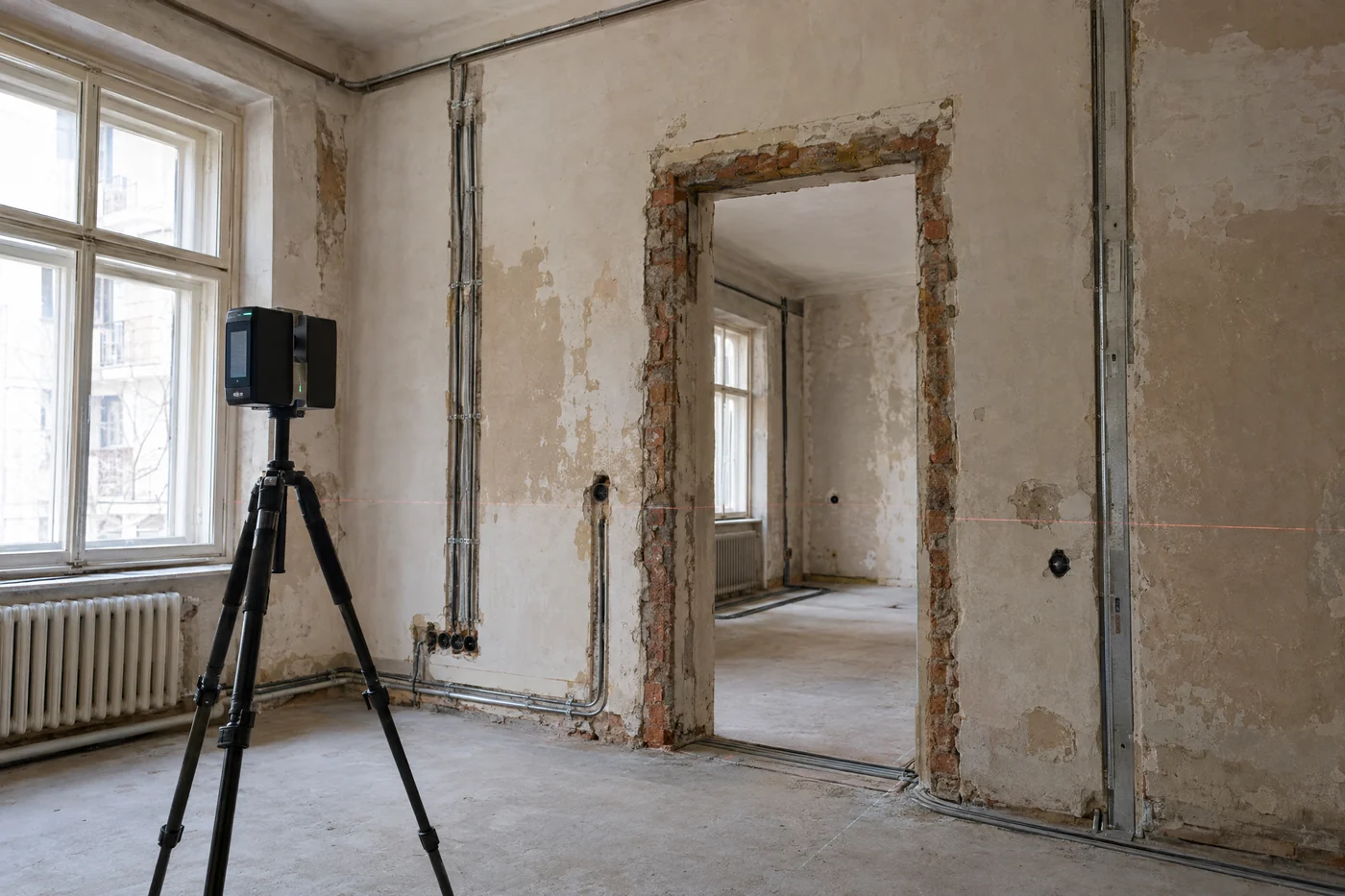
The construction industry is one of the industries with the greatest environmental impact, where sustainability must play a prominent role. In recent years, more and more emphasis has been placed on the fact that the renovation of existing buildings is a more sustainable solution from an environmental and economic point of view than new construction. Prefabricated materials, raw material extraction, transportation, and the construction of completely new infrastructure require a lot of natural resources and energy. On the other hand, modernizing an existing building can result in significant resource savings. The toolbox of digitization, especially Building Information Modeling (BIM), DIGITAL TWIN, 3D survey, artificial intelligence (AI), IoT sensors and smart home technologies, can all help us to make renovations more sustainable.
Is renovation more sustainable than new construction?
Material saving: Construction waste is one of the most significant environmental problems. The reuse of existing structures and materials significantly reduces emissions from the mining and production of raw materials.
Energy efficiency: The construction of a new building involves significant energy use, including material production, transportation and construction. In contrast, the modernization of an existing building can optimize energy use through the use of intelligent design and modern technologies, resulting in significant savings and a lower environmental impact.
Protection of the local environment: Demolition works involve significant noise and air pollution, as well as waste production, which has a harmful effect on the environment and the quality of life of the population. The sustainable renovation of existing buildings minimizes these negative effects, while ensuring the energy efficiency and functionality of the building in the long term.
Coordinated renovations and joint procurement can make design and purchasing more efficient across similar buildings. Actual savings depend on the technical scope and market conditions.
International examples of sustainable renovations
Empire State Building, New York: The iconic building underwent a comprehensive energy efficiency renovation that included new triple-glazed windows in old windows and modernized the building's heating and cooling systems. The result was an energy saving of 38%, which represents a cost reduction of several million dollars annually.
Tate Modern, London: The transformation of a former power station into an arts center exemplifies how an existing industrial building can be given a new function while preserving its original structure and reducing the amount of construction waste.
Renovation of Paris Haussmann buildings: Many 19th century buildings in France have been modernized for more sustainable energy use without having to demolish them. During the energy efficiency improvements, emphasis was placed on wall insulation and intelligent energy use systems.
Berlin’s Humboldt Forum is a different type of example. The former palace was demolished in 1950, and the new building reconstructs substantial historic facades. It should therefore not be presented as adaptive reuse retaining the original building structure.
BIM systems: Digital precision for sustainable renovations
BIM (Building Information Modeling) technology is a revolutionary tool in the sustainable renovation of existing buildings. With the help of the system, the structural and energy status of the entire building can be accurately mapped in a digital model, enabling precise planning and more sustainable construction. The following advantages highlight the use of BIM during renovations:
Accuracy and pre-simulation: BIM enables the modeling of different renovation scenarios, so it is possible to calculate in advance what effect a given intervention will have on the energy efficiency and long-term sustainability of the building.
Optimizing material use: BIM helps develop demolition and recycling strategies, reducing construction waste and minimizing the use of new raw materials.
Cost reduction and time savings: By eliminating unexpected problems in renovation projects, BIM can reduce costs and shorten construction time.
International example: The city of Amsterdam uses BIM technology for the energy-efficient renovation of historic canal houses, where a comprehensive analysis of the building's structural condition takes place through precise digital modeling.
Artificial intelligence and IoT: Intelligent renovation, sustainable buildings
The combination of artificial intelligence (AI) and IoT (Internet of Things) makes renovation projects more efficient and sustainable. With the help of AI:
Analyze energy usage patterns: AI can analyze a building's past energy consumption and make optimization recommendations for heating, cooling and ventilation systems.
Prediction and preventive maintenance: With the help of predictive algorithms, failures of the building's mechanical systems can be predicted, thus reducing maintenance costs and energy efficiency losses resulting from failures.
Sensor-driven operation: IoT-based smart sensors (such as temperature, humidity, and air quality sensors) allow the building to respond to environmental changes in real time, minimizing energy use.
International example: AI-based energy management systems are used in some municipal buildings in Berlin, which reduced the buildings' annual energy consumption by 25%.
Smart home solutions: The future of renovations
Smart home technologies, which ensure not only comfort but also energy efficiency, play an increasingly important role during renovations. Advantages of smart solutions:
Automated energy consumption: Smart thermostats and heating-cooling systems controlled by artificial intelligence dynamically adapt to the lifestyle of the residents, thereby reducing energy consumption.
Intelligent lighting and shading: Motion sensors and weather-based brightness control help minimize unnecessary energy losses.
Integration of renewable energy sources: Smart home systems are able to connect with energy production systems (such as solar panels and energy storage batteries), thus maximizing self-sustaining energy supply.
International example: In some residential areas of Copenhagen, a 40% reduction in energy consumption was achieved with the introduction of smart home systems, while the residents' sense of comfort improved.
Conclusion: Helping renovation instead of helping new construction
With the help of digitization, renovations can be made more sustainable and cost-effective than new constructions. By modernizing existing buildings, the use of materials, energy consumption and pollution can be reduced, while digitization and smart technologies help buildings operate more efficiently.
🏗 Build smarter with Toldy Construct! Design and execution in one hand. At Toldy Construct, we combine 20 years of experience in the construction industry, architectural sensitivity and a value engineering approach to create high-performance, economically attractive and future-proof architectural solutions. We optimize the use of materials, construction processes and sustainability right from the creation of the concept without compromising on quality. 🔍 Our innovative approach guarantees demanding building structures, digital construction workflows and efficient project implementation. ⚙️ We combine architectural excellence with engineering precision and digital innovation to offer solutions that are durable, functional and represent long-term value. Whether it's planning or execution, we always prioritize efficiency, sustainability and the most modern technology - because we shape the future of the construction industry. Source: https://www.clintonfoundation.org/press-and-news/general/empire-state-building-program-saves-millions-establishes-energy-efficiency-model-nationwide/
https://www.tate.org.uk/visit/tate-modern
https://www.lakaskultura.hu/cimke/gyarepulet/
https://reospartners.com/blog/decarbonizing-empire-state-building
https://www.buildingsmart.org/wp-content/uploads/2018/10/Amsterdam-Canal-Houses.pdf
Sources
https://www.tate.org.uk/visit/tate-modern
https://www.lakaskultura.hu/cimke/gyarepulet/
https://reospartners.com/blog/decarbonizing-empire-state-building
https://www.buildingsmart.org/wp-content/uploads/2018/10/Amsterdam-Canal-Houses.pdf