Redesign or another illusion?
After 2020, everyone learned: the global supply chain is not a symphony, but a minefield. The pandemic, the Suez congestion, the Russian-Ukrainian war, and then the conflicts in the Middle East only crowned the recognition that workers in the construction industry have been whispering for decades - the material does not come by itself, and digitalization alone does not pour concrete.
By 2025, we will be over panic reactions. We no longer just want to survive, but to build. However, the question is not what software to buy, but whether we know what we really want to achieve with it. The following train of thought unfolds this.
1. Pain points: when the iron does not arrive in time
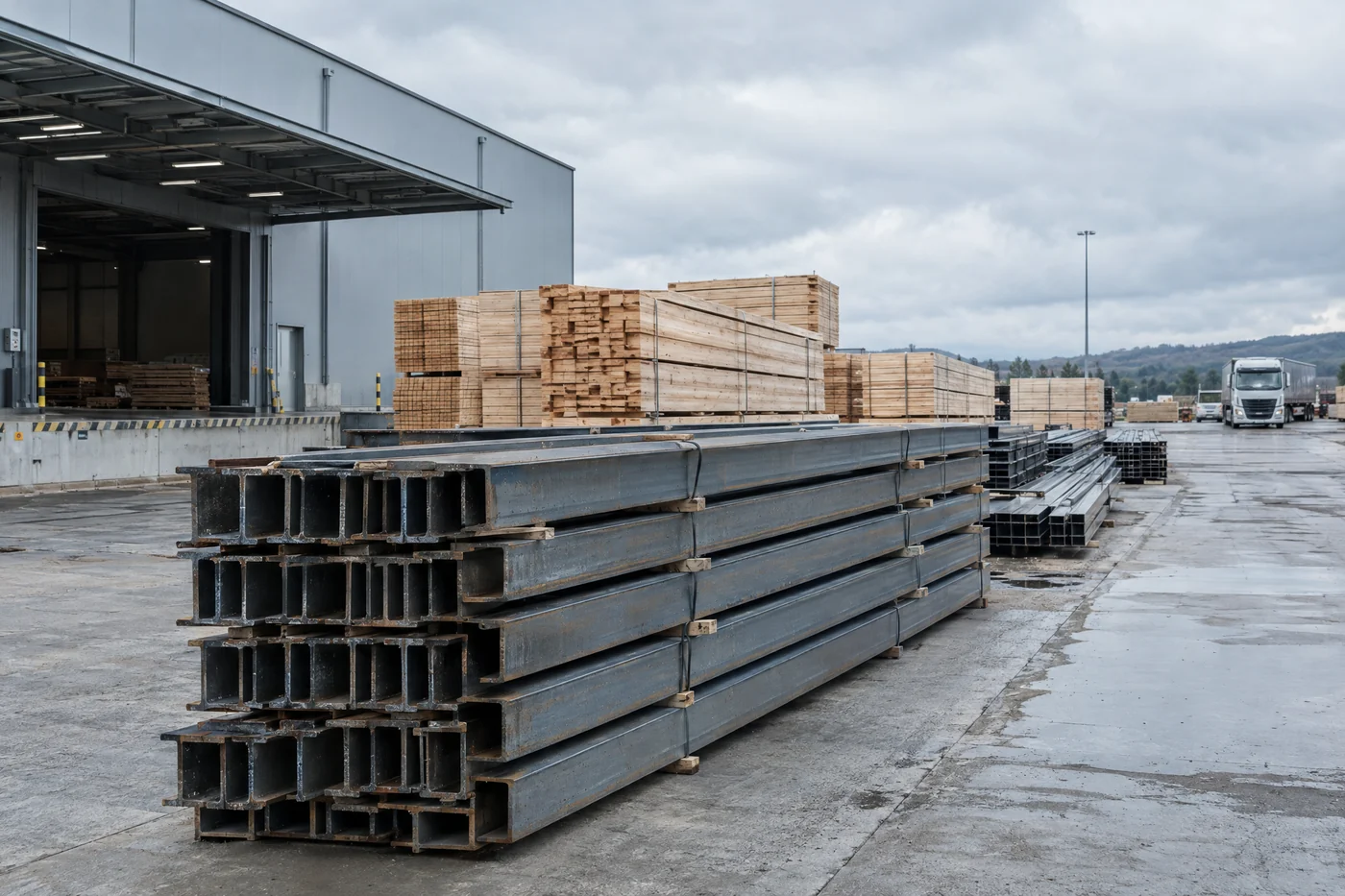
Even the biggest leap in technology won't help if the physical world resists. In the US, the price of construction inputs is still 38% higher than before COVID by the end of 2024. BIM models can be as beautiful as they are when reality breaks the timing. This is where the promise of local procurement comes in, but remember: cement still doesn't grow on trees.
➡️ Lesson: "design-for-substitution" (flexible material design) is not an option, but a survival strategy. Pricing and logistics risks must be simulated already in the concept phase - otherwise we will fail already during the tender period.
2. Diversification ≠ Security (in itself)
Just as we would step out of the local chaos, it is easy to walk into the global chaos. Diversification is still considered by many to be a magic word - new suppliers, new regions, new opportunities. But in parallel comes more contracts, more responsibilities, more audits, and most importantly: more risks.
Replacing a distant supplier may shorten delivery time but introduce new quality-assurance or documentation tasks. Decisions should consider total procurement cost and risk together.
➡️ Lesson: Diversification is only worth something if there is a data-driven decision behind it and a functional CLM (Contract Lifecycle Management). If we can't manage complexity, new partners will only mean new points of failure.
3. Artificial intelligence: miracle or icing?
GenAI is embedded in the supply chain narrative. There are places where it visualizes the stocks as a control tower, in other places it models dynamic pricing. The problem? The software is faster than the organization. According to the PwC survey, the biggest obstacle is not technology, but people - more precisely, data cleaning, lack of competences and decentralized decision-making.
➡️ Critical question: Do we know what questions we want to ask the system? A "smart" system also gives answers to stupid questions - just not necessarily useful ones.
4. Blockchain in construction: reality or illusion?
In principle, the blockchain system promises transparency - in practice, however, it is only as accurate as its data sources are reliable. If a subcontractor manually uploads the delivery note, the error is already embedded in the system. In addition, there is often no common data language between ERP, BIM and logistics platforms - Excel remains.
➡️ The harsh reality: Technology cannot do better than its input. If there are no standard data catalogs, the blockchain will only be a pretty mirror to the chaos.
5. Mandatory transparency: CSRD and the digital reality
Sustainability reporting and corporate due diligence are separate frameworks. CSRD and CSDDD differ in scope, application dates and obligations, which need company-specific checking as EU rules evolve. They do not establish one universal 2026 reporting duty for every construction business.
➡️ Strategic stake: The transparency of the supply chain is not only an auditing issue - it is also a competitive advantage in terms of financing, ESG rating and market perception.
6. Return? Only if we think at the system level
Digital investments are now being made by all companies - but the majority are not end-to-end, but island-like. A GenAI module will not solve anything if logistics data is outdated, contracts are not digital and there is no authority to make decisions.
Illustrative business-case examples
Traceability system: measure avoided search, claims or recall costs against implementation and operating costs.
IoT sensor network: reduced waste, downtime or manual data collection can be valuable if measured against a comparable baseline.
AI-supported procurement: changes in lead time should be assessed separately from the effects of data cleaning, supplier changes and work organisation.
➡️ Lesson: Payback does not depend on the technology, but on whether we can accept the operational change at the organizational level.
7. Final thought: the weakest data series decides the future
In the construction industry after 2025, the winner is not the one who installs the most software, but the one who understands what is happening in their system. The future of the supply chain is not another digitization project - but a culture change. An approach where data, physical logistics and strategic thinking can move together.
Supply-chain reliability depends on data accuracy and decision processes as well as suppliers.
Sources:
Compliance starts with establishing which rules apply to the business. Data, responsibilities and supplier information flows can then be organised around those requirements.
Omnibus Simplification Package: In February 2025, the European Commission announced the Omnibus Simplification Package, which aims to reduce sustainability reporting obligations and ease the administrative burden for companies. Source: Reuters
Compliance costs: Complying with sustainability regulations can entail significant costs for companies. Some companies can spend up to €1 million per year to comply with CSRD. Source: The Times
AI creates value when reliable data produce decision support that procurement and project teams can actually use in their daily work.
Sources
https://en.wikipedia.org/wiki/Sustainability_reporting
https://en.wikipedia.org/wiki/Corporate_Sustainability_Due_Diligence_Directive