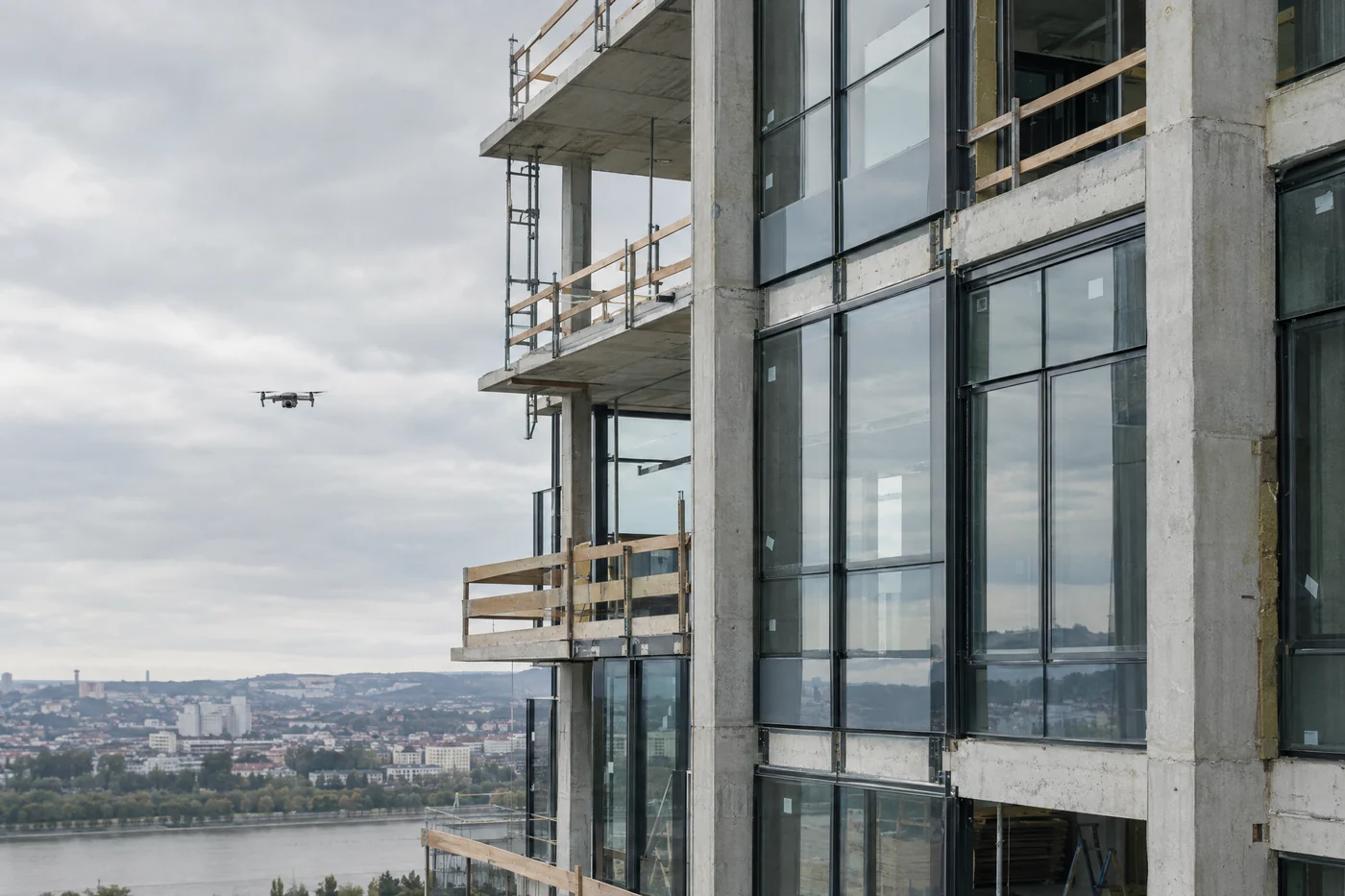
Introduction
Construction projects are increasingly complex, and time and cost pressures are unprecedented. While errors consume an average of 5-10% of the project cost, digital quality assurance - led by drones and artificial intelligence (AI) - offers a revolutionary answer: fast, accurate and safe supervision during the entire construction life cycle. GlobeNewswire
1. Why was it necessary to digitize quality assurance?
More speed, less risk - AI-controlled drones cover the same area in minutes that would take ground troops hours, without the dangerous heights and tight spaces. Amazon Web Services, Inc.
Real-time intervention - Machine vision immediately indicates cracks, moisture, or deviations from the plan, so expensive follow-up work can be prevented at an early stage. GO AWAY
Predictive maintenance - AI algorithms based on large data sets predict structural problems; in Duke Energy's network, for example, the drone-AI pair is already reducing unexpected failures in trial operation. Optical
2. Drones in the supervision of construction
2.1 What can modern drones do?
Where is accuracy today?
Photogrammetry + RTK: 1-3 cm horizontal, 2-5 cm vertical accuracy without ground reference points. UAV Coach
Drone-LiDAR: vertical deviation of up to 0.9 cm even at higher flight altitudes. JOUAV
2.2 Benefits
Site surveys with verified accuracy
Safety: personnel risk is minimized when high, low or in hazardous zones.
Speed: surveying an area of 50 hectares with LiDAR < 30 minutes.
Documentability: every flight can be retrieved and audited, so disputes can be resolved more quickly.
2.3 Disadvantages
Initial investment: RTK- and LiDAR-capable platform EUR 10-50.
Data flood: storing and processing large clouds and 8K videos requires a serious IT background.
Legislation: EU and domestic UAS regulations (e.g. BVLOS, data protection) may limit full autonomy.
3. AI in real-time data processing
Advantages
Crack detection depends on image resolution, capture distance, lighting and a validated algorithm. Reliable detection of millimetre-scale defects cannot be assumed for every drone survey.
Real-time alert: instant message to the field team.
Accuracy can improve through new verified training data and repeated validation. Another flight does not, by itself, mean that the model automatically learns from the images.
Disadvantages
Data protection: where footage contains identifiable people or other personal data, applicable privacy requirements must be met. The purpose, access permissions and retention period should be defined in advance.
"Black box" effect: the explainability of the model is the key to industry acceptance.
Training requirement: drone pilot + AI operator competence is lacking in the Hungarian market.
4. Integrated workflow (Drone + AI)
Autonomous flight planning - download RTK points, route optimization.
Data collection - RGB, LiDAR, thermal sensors in a single flight.
Edge processing - pre-filtering on the onboard GPU; critical error immediate push message.
Cloud AI analysis - comparison with BIM, quantity deviation, safety.
Dashboard & report - visual map, 3D model, KPIs and report export.
According to what was said in Optelos' 2024 Utility Analytics Week presentation, thanks to the integrated workflow, operations achieved cost savings of up to 40% and significantly increased uptime. Optical
5. Visions of the future (2025 → 2030)
Full autonomy - BVLOS flight combined with docking stations.
5G + Edge - high bandwidth live stream, local inference without delay.
Generative AI - plan-actual 3D comparison with automatic correction suggestions.
Carbon footprint monitoring - AI calculates the CO₂ profile of the construction site in real time.
6. Summary
Drones and artificial intelligence already enable centimeter-accurate, fast and safe quality assurance in general construction. Although the technology requires investment and knowledge, the drastic reduction of errors and accidents, the fast ROI and the premium customer experience are tangible advantages. Those who act now can forge a competitive advantage in the digital construction industry of the future.
Sources
DJI Enterprise - Matrice 350 RTK: Specifications (2024) DJI
UAV Coach - Drone Surveying Guide (2025) UAV Coach
JOUAV - Everything You Need to Know about LiDAR Drone (2024) JOUAV
AWS Machine Learning Blog - AI Workforce: Using AI and Drones to Simplify Infrastructure Inspections (2025) Amazon Web Services, Inc.
Globenewswire - Drone Inspection and Monitoring Global Market Report 2024-2030 (2025) GlobeNewswire
IARJSET - Remote Monitoring of Construction Sites Using AI and Drones (2024) IARJSET
Optelos - Utility Analytics Week 2024 Recap: Drone Inspection and AI in Utilities (2024) Optelos
Sources
https://iarjset.com/wp-content/uploads/2025/01/IARJSET.2024.111267.pdf
https://optelos.com/drone-inspection-and-ai-technology-in-utilities/
https://uavcoach.com/drone-surveying/