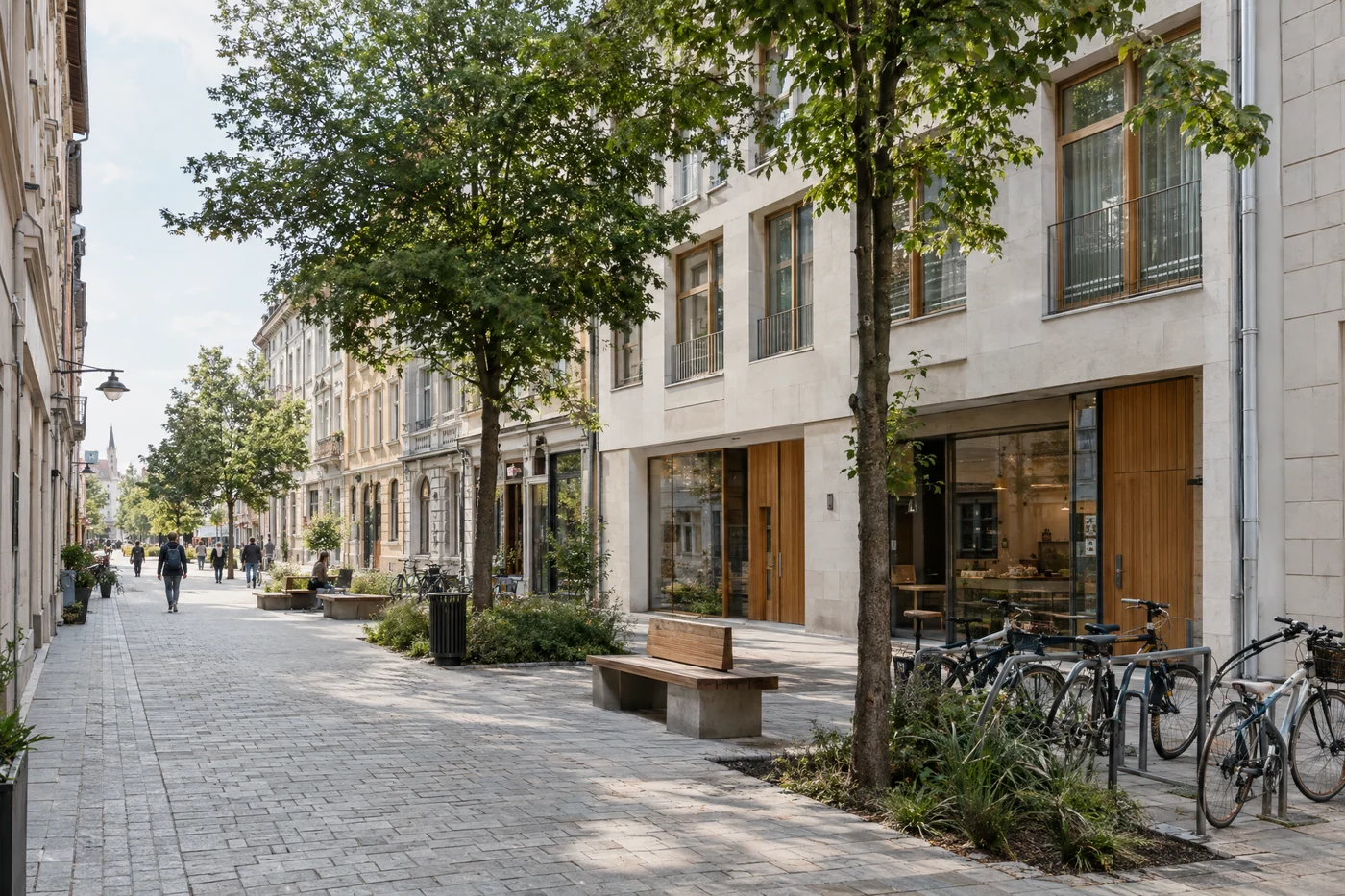
In urban politics, "human scale" is a magical adjective today. It is there in every concept, it is included in every application, every mayor is happy to say it. But if we peel back the slogans, it becomes clear: "human scale" is a stepping stone and bench in most places. And nothing more.
The real human scale, on the other hand, is about traffic management, conflict management and measurement. Not about the color of the candelabra. Where this is taken seriously, the quality of life has really changed. Where not, the "community space" is actually a set.
What do working cities show?
Barcelona - Superblocks. Dense fabric, little space, but the city has returned the interior of the neighborhoods to pedestrians. Noise and pollution have decreased and community living has increased. The innovation was not in space, but in the fact that traffic was reorganized, and the effects have been measured for years.
Ghent - Circulation Plan. In 2017, the entire city center was reorganized: zones were drawn, transit traffic was outsourced, and the inner city remained for the locals. They didn't build statues, they reduced traffic. The result: more bicycles, more pedestrians, a more livable center.
Oslo - life from the parking lot. Thousands of parking spaces were cut from the city center. The economy did not collapse, on the contrary: pedestrian traffic increased, public spaces became full of life. In 2019, not a single pedestrian or cyclist died in a road accident in the city. This is not PR, this is Vision Zero.
Paris - school streets and quayside. For them, the "human scale" meant that they put the children's safety first. The area around hundreds of schools was closed to cars, and the right bank of the Seine was completely returned to the people. Air quality has improved, community life has been invigorated.
The common denominator
Clear target system. Not "it should be beautiful", but: fewer accidents, cleaner air, more pedestrians.
Experiment and then finalize. Temporary columns, painting, mobile green surface. If it works, the concrete will come.
Data, not feeling. There is no success without measurement: noise, air pollution, traffic, accident statistics.
Political shield. The thematization of children, schools, and health shatters the "ban" narrative.
What does this mean for us?
In a Hungarian city, "human scale" is achieved when:
We don't push the paving stones, we manage the traffic.
We do not communicate as "anti-car", but as a benefit of time and health.
It is not a visual investment, but a series of continuous, measurable, experimental steps.
Honestly: if there is no monitoring, all investments are empty PR. And the townspeople will figure this out sooner or later. If, on the other hand, there is data and a target system, it is possible to create social spaces on a human scale even in a dense urban fabric with a lack of parking and conflict.
Cue
The "human scale" is not a bench and geraniums, but a strategy. If the decision-maker is able to confront the passing traffic, if he is able to measure and hold them accountable, then there will be a real community space. If not, the paving stone remains. And the paving stone is not a step, just a covering.
Sources
Barcelona Superblocks - environmental and health effects.
Ghent Circulation Plan - sustainable transport turnaround.
Oslo - Vision Zero, downtown parking exit.
Paris - school streets and Seine bank air quality impact.