As architects and economic experts, we now look not only at how much it costs, but also at what a material does to the energy consumption of the building, the health of the occupants and the overall carbon dioxide balance. In 2025, two biologically based materials jumped forward in the international professional discourse:
mycelium-based insulation and interior design panels
hempcrete
Both are good examples of what we call biomimetics: we learn from the workings of nature and transfer this to architecture.
What is biomimetics in construction?
The essence of biomimetics:
Let's see how nature solves a problem - and copy it smartly.
Forests bind and store carbon dioxide - we are also looking for materials that do not produce extra CO₂, but rather absorb it.
Bio-based materials rely on different biological processes. Hemp absorbs carbon dioxide through photosynthesis while growing. Fungi do not photosynthesise: mycelium grows on organic nutrients and can bind plant-based by-products under suitable production conditions.
The result: building materials that fit into a circular economy, which at the end of their life cycle are not a problem, but a resource.
Mycelium - thermal insulation and inner panel made of mushroom yarn
What is mycelium?
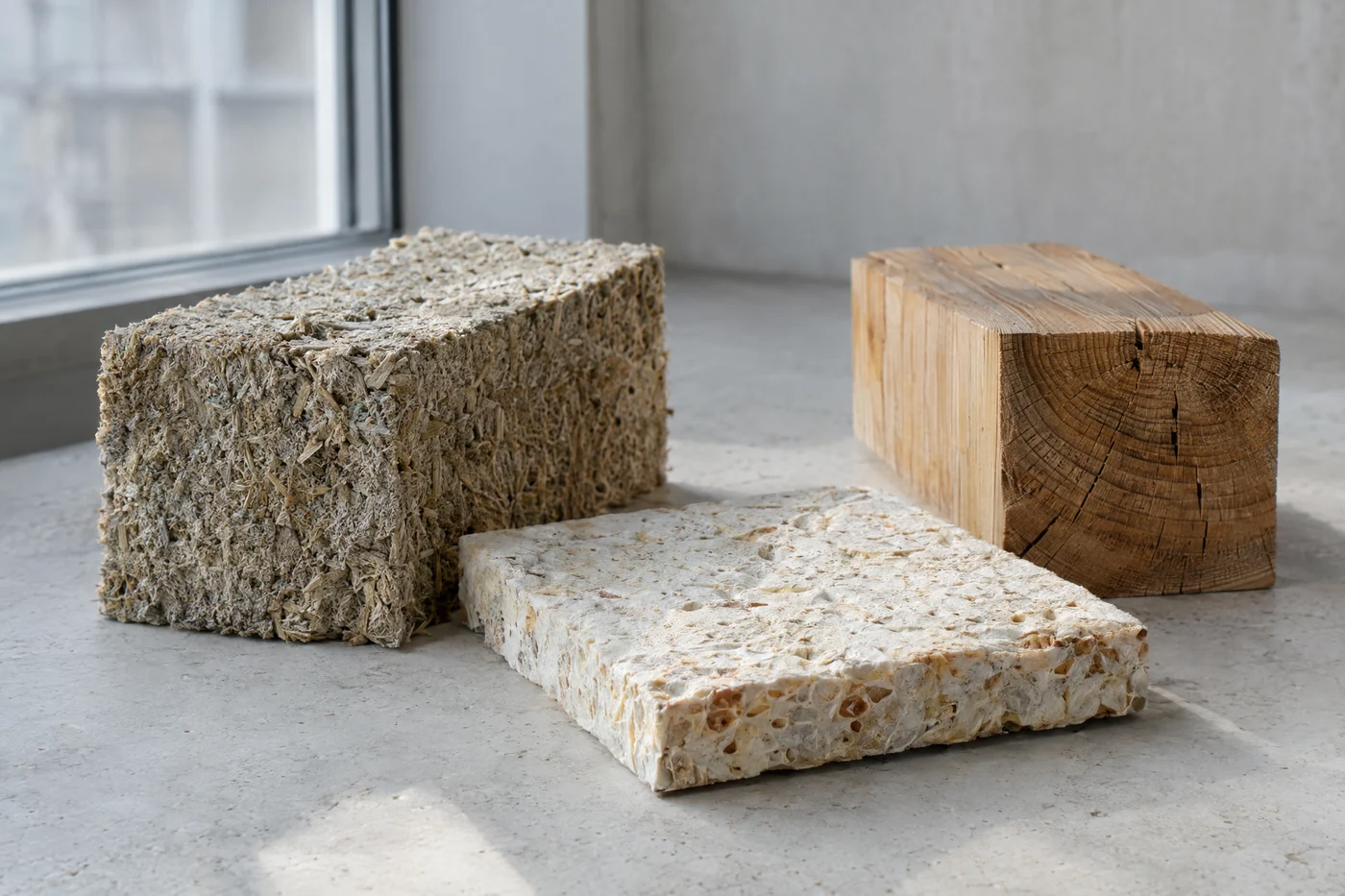
Mycelium is a network of fungal filaments. Grown on a suitable substrate, it can bind plant particles together. Subsequent processing and treatment determine the properties of the finished composite.
What makes mycelium strong in construction?
Good heat insulator: according to research, the thermal insulation capacity of mycelium-based composites is in such a range that they can be a real alternative to traditional foam insulation.
Fire performance depends on a mycelium composite’s composition, density and treatment. Building applications must rely on the tested classification of the specific product.
Indoor suitability: a natural origin does not automatically mean zero emissions. Binders, additives and surface treatments also require assessment.
End of life: compostability depends on the complete product composition and available treatment process. Coatings or additives may limit this option.
Where is the market today?
Mycelium-based interior acoustic and decor panels have already appeared in Europe and around the world, for example as wall coverings for offices and apartments. Reval
There are manufacturers that offer thermal insulation boards specifically designed to replace traditional foam insulation.
There are already projects where mycelium panels are tested in large-scale rental apartment or family house projects, especially in the countries of the global South, as an accessible and cheap solution to the housing crisis.
Economic aspects
In the short term, mycelium panels may seem more expensive per m² than a simple rockwool or EPS. At the same time:
they are built on agricultural waste, so a local value chain can be built on them,
their good thermal insulation ability reduces heating and cooling costs,
their compostability reduces the costs of end-of-life disposal,
the fact that we use bio-based and circular materials is also a strong argument for "green" ratings (ESG, EU taxonomy, green credit).
From the builder's point of view, this means: we don't always choose the cheapest material, but the one that pays off the most in the entire life cycle.
Hemp concrete - when the wall becomes carbon negative
What is Hemp Concrete?
Hempcrete is a lightweight composite:
chopped hemp stalks (hemp powder)
lime-based binder
water
It is not usually used for load-bearing purposes, but it is an excellent wall and slab filler, heat and sound insulation, and buffer layer.
Why is it considered "carbon negative"?
Hemp grows extremely fast, reaching a height of up to 3-4 meters in 4 months, and binds a significant amount of CO₂ during growth.
According to life cycle analyzes (LCA):
compared to its own weight, hemp powder binds much more CO₂ than is released during cultivation and processing,
Hempcrete’s carbon balance depends on binder production, transport and end-of-life assumptions as well as biogenic carbon storage. A carbon-negative claim requires a documented life-cycle assessment with explicit boundaries.
Simply put:
The wall is not only "not as bad" as concrete - it actually stores CO₂.
A healthier indoor climate
One of the biggest advantages of hemp concrete is that it "breathes" and regulates moisture:
the wall absorbs excess moisture when the relative humidity is high,
and slowly returns when the air is drier.
Moisture-buffering materials can moderate changes in indoor humidity. They do not guarantee a particular relative humidity and cannot replace ventilation, moisture-source control or appropriate construction details.
In the post-pandemic period, when everyone is much more sensitive to indoor air quality, this is a serious advantage:
less mechanical dehumidification, air conditioning,
less mold,
more stable, natural microclimate.
Economic page
The hemp concrete wall:
good thermal insulation and high heat storage mass - cools down more slowly, heats up more slowly, thus reducing the need for heating and cooling,
helps to improve the energy rating of the building,
in more and more green credit and support schemes, it is a distinct advantage if bio-based, carbon-negative materials are included in the technical content.
Construction can be even more expensive today because there are few experienced contractors, but in the medium and long term:
the lower overhead,
the valuable, "green" property
and due to the expected tightening of carbon regulations
hemp concrete will become an increasingly rational choice.
Mycelium + hemp concrete - where do they fit in a Toldy building?
Today, realistically, these materials work well in hybrid systems. For example:
Load-bearing structure: reinforced concrete, steel, wood or a combination of these.
Wall and slab filling: hemp concrete, where the vapor and heat buffer effect is important.
Interior coverings, panels: mycelium-based acoustic and design panels, where the surface is also visibly "green", which is not negligible from the point of view of marketing and tenant attraction.
A Toldy Construct project with this logic:
technically safe (reliable load-bearing frame),
economical in operation (better heat and humidity control),
Carbon claims should be supported by product-specific data, clear assessment boundaries and a verifiable calculation. A material’s name alone does not establish an environmental benefit.
How does this help the investor?
Lower operating costs
better thermal insulation + ability to store moisture and heat = less heating/cooling.
Higher property value
due to green ratings, ESG expectations, and tenant awareness, the "green house" can mean a premium.
Better financing
carbon-negative, bio-based material is a major plus for banks and investors.
Communication advantage
a house built from mycelium panels and hemp concrete walls is a story in itself, which is easy to sell on the market.
Summary
Mycelium and hemp concrete are no longer science fiction, but real, commercially available building materials that fit the goals of the circular economy and carbon neutrality.
Mycelium can be used to produce lightweight bio-based composites. Thermal, acoustic and fire performance should be assessed using tests of the specific product.
Hempcrete can offer useful properties in non-load-bearing assemblies. Its environmental benefits and conditions of use need product-specific assessment.
As architects and economic experts, we see:
whoever starts thinking with these materials today is not only good for the planet, but also for their own wallet in the long run.
Sources
https://www.mdpi.com/2071-1050/17/16/7223
https://www.sciencedirect.com/science/article/pii/S0734975025000035
https://mycopor.eu/mycelium-based-materials-and-the-circular-economy/
https://www.revalu.io/journal/nature-based-solutions-top-6-mycelium-building-materials
https://apnews.com/article/621bc9707379ea70358e1ab8aa15bec2
https://www.carmeuse.com/eu-en/applications/building-materials/hempcrete
https://www.designlife-cycle.com/hempcrete
https://pmc.ncbi.nlm.nih.gov/articles/PMC10672900/
https://www.ukhempcrete.com/wp-content/uploads/2016/11/Hempcrete-FAQs-UK-Hempcrete.pdf
https://www.hempwellness.co.nz/blogs/hemp/hempcrete-creating-healthy-and-sustainable-living-spaces